


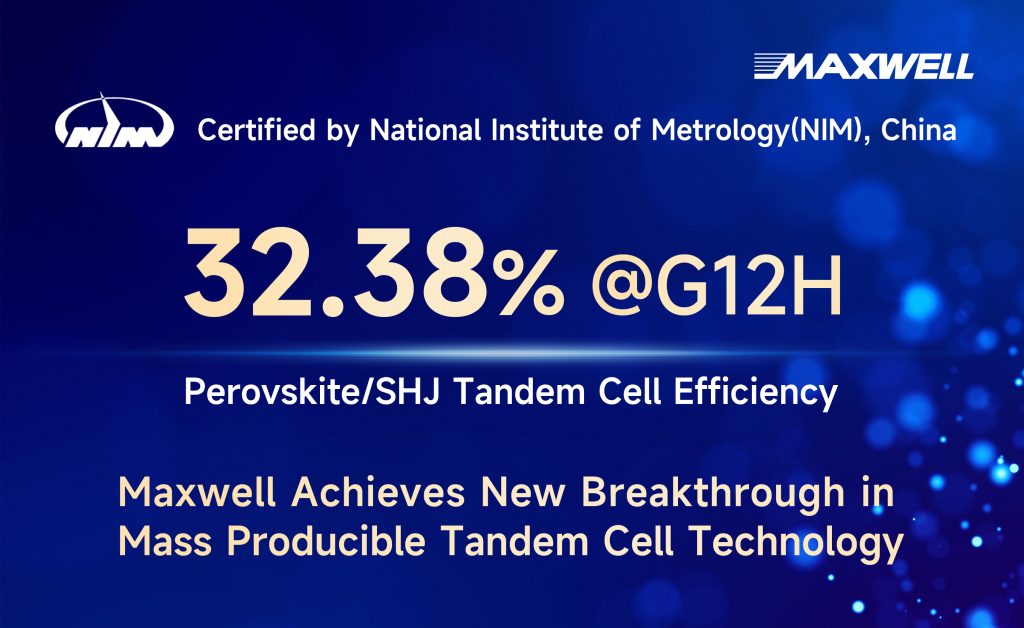
Recently, a perovskite/SHJ tandem solar cell (G12H), developed by Suzhou Maxwell Technologies Co., Ltd. (“Maxwell” or the “Company”), using its independently developed mass-producible equipment and processes, achieved a certified power conversion efficiency (PCE) of 32.38% from China’s National Institute of Metrology (NIM). This certification not only marks a significant breakthrough for the Company in tandem cell mass-production technology,but also paves the way for its industrialization.
◼ Building on Full-Line Tandem Cell Solutions, Scaling New Heights in Mass-Production Technology
The fabrication of this high-efficiency cell integrates core technologies from Maxwell’s full-line solution for large-size, full-area tandem cells with an annual capacity of 200 MW. These include: high-stability, high-uniformity PECVD/PVD vacuum coating technology; pre-deposition printing technology that significantly reduces material costs, inkjet printing technology combining high material utilization with high throughput, and efficient, high-throughput plate-type temporal ALD vacuum coating technology. All equipment, materials, and processes deployed are viable for large-scale mass production.
The 32.38% efficiency on a commercial-grade cell size further attests to the sophistication and comprehensiveness of the Company’s tandem cell full-line solution.
◼ Research Gains International Recognition with Publications in Top Journals
While advancing industrial technologies, Maxwell has also made consecutive breakthroughs in cutting-edge tandem cell research, with its findings earning recognition from leading international journals including Nature and Advanced Materials.
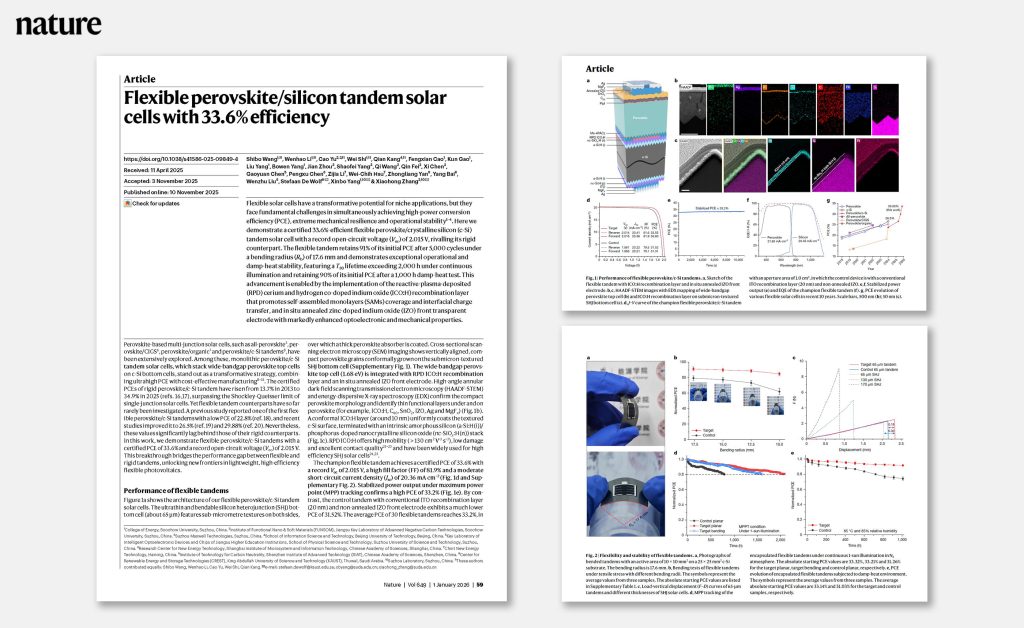
In collaboration with teams from Soochow University and Beijing University of Technology, the Company developed a flexible perovskite/silicon heterojunction tandem solar cell with a certified efficiency of 33.6%. This landmark study, published in Nature as “Flexible perovskite/silicon tandem solar cells with 33.6% efficiency,” overcame core challenges in the efficiency and stability of flexible tandem cells. Owing to their high efficiency, lightweight, and bendable nature, these flexible cells offer a novel energy solution for applications ranging from building-integrated photovoltaics (BIPV) (such as curved roofs and glass curtain walls) to special scenarios like space power systems.
(Paper link:https://www.nature.com/articles/s41586-025-09849-4)
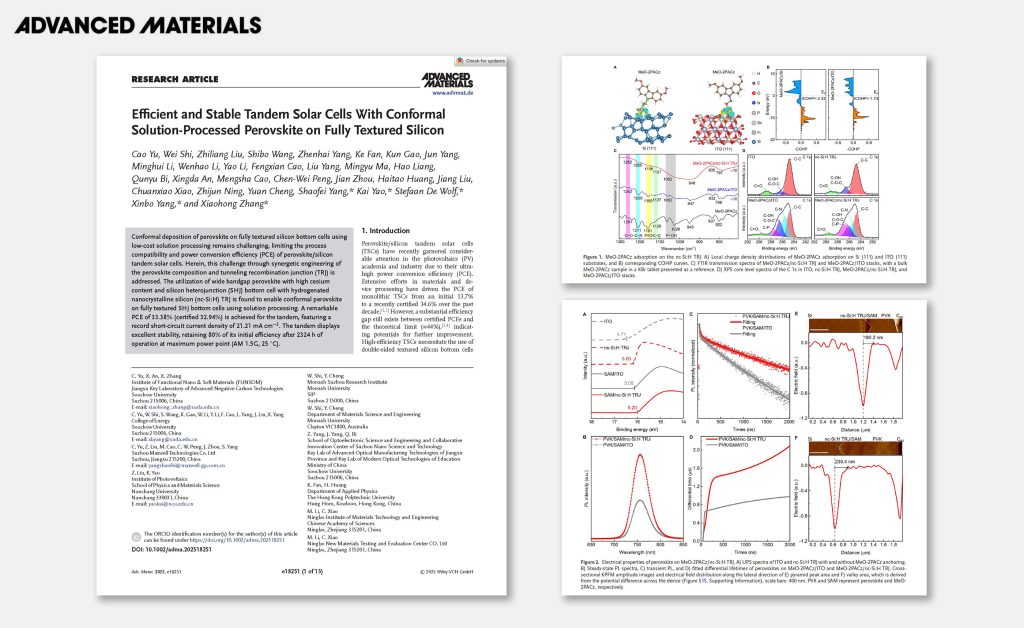
Furthermore, research conducted jointly by Maxwell, Soochow University, and Nanchang University was published in Advanced Materials. The paper, titled “Efficient and Stable Tandem Solar Cells with Conformal Solution-Processed Perovskite on Fully Textured Silicon,” successfully addressed a key industry challenge. By synergetic engineering of the perovskite composition and tunneling recombination junction (TRJ) structure, it enabled high-quality conformal deposition of perovskite layers on fully textured SHJ bottom cells using a low-cost solution process.
(Paper link: https://doi.org/10.1002/adma.202518251)
The NIM efficiency certification, together with these consecutive top-tier publications, demonstrates Maxwell’s comprehensive leadership in perovskite/silicon tandem cells—excelling in both “frontier exploration” and “industrialization advancement.” The Company continues to push the efficiency boundaries of photovoltaics while working to bridge the path from laboratory innovation to scaled manufacturing through deeper industry-academia collaboration and application diversification, thereby charting a broader future for solar energy.